"The record of the genealogy of Jesus, the Messiah, the Son of David, the Son of Abraham." Matthew 1:1
Most of us are accustomed to stories that begin with "Once upon a time...", or "It was a dark and stormy night...", or even "Space, the final frontier." Yet here, Matthew begins his Kingdom Gospel with a lesson in genealogy. Why does the story of Jesus begin with such an academic preface?
Because Matthew wants to be very clear right from the start that this Jesus is not just any man. He is the Messiah — the promised Anointed One. He is King of Israel — rightful heir to the throne of King David. He is History Fulfilled — what God started with Abraham he brings into fulfilment with Jesus of Nazareth.
Before the real story begins Matthew lays out for his listener the path through Israel's history that led to the man Jesus. You'll notice I use the word listener instead of reader. I have long been convinced that the scriptures were designed to be heard. It is why I am a Biblical storyteller. As the gospels were circulated in the early church you can be certain they were read aloud in the congregation. I believe that this was kept in mind when the gospel writers penned their words.
Imagine with me for a moment the response in the minds of the Jewish believers in Matthew's congregation as they heard this litany of names they had lived with all their lives.
Abraham, Isaac and Jacob – the three great patriarchs of Israel. Boaz – the protector and husband of the faithful Ruth. Jesse – the father of the great king David from who's branch it was foretold the Messiah would come. Jehoshaphat – the king who led Israel back to faith in the God who would deliver them from their enemies. Zerubbabel – one of the leaders in the rebuilding of the temple at Jerusalem after the exile to Babylon. Each of these names and others in the list would have stirred memories in the hearts of the Jewish listeners.
But there are other names there as well; names not to be expected. Tamar - who held Judah accountable for his actions. Rahab - protector of the Israelite spies as they scouted out the Promised Land. Ruth – faithful Moabite who refused to abandon her Hebrew mother-in-law. And Bathsheba – wife of the Hittite who would one day give birth to the great King Solomon. They were women, and for a woman to be mentioned in a lineage would have been unusual all by itself. And yet there is more, for these women were also Gentiles.
Imagine again the response when the listeners heard the names of these Gentiles held as examples of great faith in the Hebrew scriptures. Imagine them then looking at the Gentiles among them who had come to follow Jesus, the Christ, and wondering that they had never seen the obvious before. That the God of Israel was indeed the God of all nations.
This then is the carrot that Matthew dangles before his listeners. This is the story he is about to tell. The culmination of the history of Israel, the coming of the promised Messiah, and the restoration of the rightful heir to the throne of David, all brought together in the life of one man – Jesus of Nazareth.
And yet, to the attentive listener there is a flaw. The chain is broken in the final link. The man Joseph is indeed a true son of David, but he is listed only as the husband of the virgin named Mary, mother of the Nazarene, not as the father of Jesus. As well no explanation is given for the inclusion of yet one more woman in the lineage of this would be king.
Matthew knows the break is there, and he knows they have discovered it. His explanation is forthcoming in the next episode – "The Birth of a King."
Shalom.
(Exploring the Kingdom Gospel - episode 2)
Friday, November 24, 2006
The Lineage of a King


Monday, November 20, 2006
Exploring the Kingdom Gospel
As part of my preparation of the Gospel of Matthew as story, I've decided to review the gospel focusing specifically on the Kingdom of God dynamic. When preparing a story for telling it is a necessary part of the process to examine the story from different angles so as to understand the perspective of all involved. To help me in this process I've decided to share my observations in this forum. (I’ll be publishing more often than I have been, but I can’t promise more than that.) However, I do invite you to participate in the process. Whatever input you feel led to provide will be welcome. You could question my observations, offer up alternatives, or just let me know if what I have come up with makes sense to you. Whatever the feedback, it will be most helpful and greatly appreciated.
To Begin...
One of the first things that needs to be considered when preparing a story is – who was the story originally intended for? Many scholars are of the opinion that the gospel was written by a Jew for Jews because of the numerous references to information that would have been of great interest to the Jewish community. While this certainly seems to be the case, many commentaries point out the number of times Matthew writes as if he is outside of the Jewish community. For example, he refers to the Jewish houses of prayer as "their synagogues." In fact such is the rhetoric against the Jewish leaders that in the past many Christian preachers have used Matthew's gospel as justification for their anti-Semitic views. How do we explain this?
After researching a number of sources, I find myself wondering if Matthew's church (he's the only gospel writer to use the term) was in fact a group of Jews who, having come to belief in Jesus as Messiah, had been forced to leave their synagogue; thrown out of the community for their blasphemy. They were struggling, faced with the question of how do they maintain their heritage as the people of God and Abraham while at the same time embracing this new spiritual reality. To help them answer this question Matthew writes his gospel. He clearly sets out to prove that Jesus of Nazareth is indeed the promised Messiah of the Jewish people.
And yet, he just as ardently presents salvation through Jesus Christ as being for all the nations. Cast out from the synagogue these Jewish Christians now find themselves worshipping the Messiah in the company of Gentiles! For this reason it is important for Matthew to include examples of the faith found by Jesus among the Gentiles he encounters. He wants them to see a larger kingdom that encompasses not just the twelve tribes of Israel, but the world as a whole. He knows that if they are all to be productive citizens of the same kingdom they will have to overcome their differences. (A lesson some modern nations have yet to learn.)
Having established our 'audience' we now need to examine the other aspects of the gospel story, namely, characters, setting and plot. We will examine plot as we work our way through the gospel in the coming weeks. However, because plot most often involves the interactions of the characters with each other and their settings, lets take a quick look at these elements in Matthew's story.
As I just said plot involves the interactions of the characters in the story. Some of these interactions will involve conflict while others will bring characters together in a variety of ways. The scope of this interaction is determined by what type of character they are. There are, for the most part, three kinds of characters in a story.
Round characters are those with sufficient character and personality traits displayed that we are able to create in our minds a near complete picture of just who they are. They are the characters who seem most real to us and with whom we tend to develop the most empathy. Jesus, of course, is the most round of all the characters. As the hero of the Kingdom Gospel he is the one Matthew most desires that we come to understand and relate to, both as King and Messiah.
The Disciples are also, to varying degrees, a round character. I say "a character" because, like most groups in a story, the disciples function as a single character. They are in a very real sense an 'everyman', a character that all of us can relate to in some way. The occasional glimpses we get of the individuals within the group highlight specific character traits that can be found in all of us. While most of the disciples are individually flat (definition in a moment) it is as a group that they develop into a fully-rounded character with all of the strengths and weaknesses that go with being truly human.
Flat characters are those who display very few traits. Unlike round characters they are very predictable in their behaviours. They tend to operate from one or two root traits that determine, in large part, their course of action. The Religious Leaders (scribes, pharisees and priests) are the greatest example of a flat character in this story. Like the disciples, the group as a whole is regarded as a single character and they all follow the same path. In the case of the religious leaders their root trait would seem to be hypocritical, to the point of being 'evil.' Their sole motivation seems to be self-preservation in order to retain power.
The Crowds are also an important flat character. Their traits are few and uncomplicated. They either support Jesus or they oppose him depending on the occasion. They represent the wave of public opinion and raise for us the important questions: Is this man really the Messiah? How can he do such things if he is not from God? Who is our king? The crowds are there, in part, to ensure that these questions are raised and debated in the mind of the reader/listener.
Stock characters are those that exhibit either only one trait or no traits at all. In the kingdom gospel the minor characters are in fact all stock characters. The lepers, the blind, the cripples, the relatives of the disciples, the Roman and temple guards, and the myriad of other individuals that come into the narrative, perform their function and leave it just as quickly. That is not to say they do not have an important role in the story of the Kingdom. In God’s kingdom all have their purpose; however, in general they must be regarded as minor characters.
Now I realize this seems like a cruel way to dismiss these people; after all, they were real people that met and were affected by the person that is Jesus Christ. But I ask you to understand that this kind of categorizing helps the storyteller to make decisions about how a story is told. It is not a reflection of the validity of anyone as an individual. That happens at a whole other level.
The settings used in the Kingdom Gospel are also of great importance and will be discussed in detail as we go along. But here it should be noted that Jesus’ arrival, death and ressurection take place at both a geographical and temporal crossroads. Jerusalem and its environs were located at the centre of all the major trading routes. Peoples from every nation in the Roman Empire and beyond were present and had varying degrees of influence on the culture of the day.
And while the time period has become of crucial significance to us, creating a fulcrum across which even our calendar rotates, it was also a crucial time for those who had no idea regarding the significance of the events about to unfold. Rome's power was at its height and the beginnings of revolution were in the air. While not the only point of conflict in the empire, Israel was about to take a crucial turn in its relationship with the emperor. Long protected from many of the requirements of being in the empire, many in Rome were starting to tire of the constant complaints from the Religious Leaders, and the eyes of many other occupied regions were waiting to see what Rome would do about Israel.
Well that’s it for now. I apologize for the great length of this discourse, and the absense of any real point to take away with you. But I felt it was necessary to establish this as the perspective from which I would be exploring the Kingdom Gospel. Next time (hopefully later this week) we'll get started into the meat of the story itself with the first episode – "The Lineage of a King."
Shalom.
(Exploring the Kingdom Gospel - episode 1)
Monday, November 06, 2006
Lest We Forget
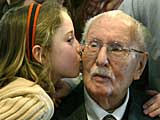
There are three Canadians left alive who served during the First World War. They are: 105-year-old Dwight (Percy) Wilson (shown in photo getting a kiss from his grand-daughter on his 105th birthday) and Lloyd Clemett and John Babcock, both 106. They are the last remaining links to the 619,636 Canadians who served between 1914 and 1918. Soon, when they too have passed on, there will be no one left to say, "Thank You" to from that terrible time in our history.
The Dominion Institute has suggested that when the inevitable day comes that the last of Canada's WWI veterans passes, they should, on behalf of all the 66, 655 Canadians who died in service to their country during that war, be given a formal state funeral. I fully agree.
The passing of the last WWI veteran will, in fact, mark the passing of a generation, even an era. We should do all we can to make sure that their sacrifice does not fade from memory. To give the last veteran a state funeral as a significant tribute to every soldier who died in WWI is by all means a very fitting act. I hope you agree as well.
I am therefore asking you to join with me in asking our federal government to do just that. There is an online petition available to be signed at www.dominion.ca/petition . You may well have heard about this on the news by now, so what I have written here is not news. Some of you have already signed and for that I thank you. If you hadn't please take a moment to click on the link above and do so. You will receive a verification email that requires you click another link to verify your email address is a valid one. The whole process takes only a few minutes.
The passing of the last Canadian WWI veteran will only happen once in our entire history. Let's make sure it is an event that is well remembered.
Shalom...
Monday, October 02, 2006
Blessed are the meek...

Like many of you I have spent this week watching the events unfold around a small Amish community in Pennsylvania. There is a part of us that can rationalize the idea of shootings in crowded inner-city communities where our children walk to school through all the horrors that modern urban life has to offer, but who among us ever thought that Amish country was also a breeding ground for this kind of behaviour?
Even more remarkable than the fact that such an event would take place in this small rural community lost in time, is the response of that same community. It is a response that in many ways is also lost in time. It is a response that has caught the attention of many people in North America and has them wondering about their own responses. And I would like to suggest that the people who should be paying the most attention to the gentle ways of these gentle people are the Christians of Canada and the United States.
It has been somewhat disheartening for me to watch the behaviour of my fellow Christians in the press of late. It seems that the default reaction by many believers to people who disagree with them is to unload all of the bile and hate they've been storing up. Condemning people to any or all of Dante's 9 levels of hell, wishing disease and calamity upon them, questioning their humanity, comparing them to various tyrannical dictators (Hitler remains the favorite), even death threats are among the list of responses the practitioners of "Christian Love" levy at those who would dare to oppose them. It all calls to mind the lyrics of an old song by the Christian rock-band Petra...
"Seen and not heard, seen and not heard
Sometimes God's children should be seen and not heard.
Too much talk and not enough walk
Sometimes God's children should be seen and not heard."
Not so the people of faith in this Amish community that has suffered so devastating a blow. The people of Lancaster County took a very different view.
"The grandfather was there and he made a point. They are instructing their kids not to think evil of the man who did this. I think that was the most moving of all,” Rev. Rob Schenck of the National Clergy Council told CBS.
"I don't think there's anybody here that wants to do anything but forgive and not only reach out to those who have suffered a loss in that way but to reach out to the family of the man who committed these acts," Jack Meyer told CNN.
"The hurt is very great," she said, "but they don't balance hurt with hate."
Today's pastors and Christian writers have a great deal to say about how to live the Christian life in the modern world. They spend a lot of pulpit time and ink on paper trying to re-create the Gospel in a flavour that the 'post-moderns' can find easier to swallow. But in a small community that for the most part is still in the 18th century, the teachings of Jesus are being lived out for all the world to see, and the world is listening.
This small community that has rejected cell-phones and computers, even gas engines and the automobile has refused to reject the man who committed this terrible act (Charles Roberts). They get 'closure' on the matter not by seeing that the shooter is vilified and the world never forgets how evil he was; but rather by forgiving what many consider unforgivable. They reach out not to obtain revenge, but to extend compassion and comfort to the Robert's family in the understanding that they too have suffered loss - a husband and father. They do not alter their view of the Gospel to address a circumstance they never imagined facing, instead they cling to centuries old teachings from the scriptures to get them through whatever happens no matter how unfamiliar.
It truly speaks to the power of the Gospel itself to make a louder statement than any preacher or evangelist ever could. We don't need special effects or a New Testament re-written in text-message style wording. We don't even really need to trip over ourselves trying to be seeker-friendly. What we really need to do is live the life we have been called to live -- honestly, every day. We need to remember that the timeless message we have been called to share with the world is just that -- timeless.
That doesn't mean we need to get rid of the tools of the electronics age, but we do need to remember the message we are called to deliver. Marshall McLuhan said, "The medium is the message," and nowhere is that more true than in the case of the Gospel of Jesus Christ. That is because we are the medium by which the message is transmitted. It is not the computers, the Internet, the new translations, the church programs and activities that communicate the gospel -- It is us! And as we've learned this week, a gentle word, a firm resolve, and a forgiving embrace speak louder than anything sermon we might preach.
Blessed are the poor in spirit, for theirs is the kingdom of heaven.
Blessed are those who mourn, for they will be comforted.
Blessed are the meek, for they will inherit the earth.
Blessed are those who hunger and thirst for righteousness, for they will be filled.
Blessed are the merciful, for they will be shown mercy.
Blessed are the pure in heart, for they will see God.
Blessed are the peacemakers, for they will be called sons of God.
Blessed are those who are persecuted because of righteousness, for theirs is the kingdom of heaven.
Blessed are you when people insult you, persecute you and falsely say all kinds of evil against you because of me. Rejoice and be glad, because great is your reward in heaven, for in the same way they persecuted the prophets who were before you.
You can't say it any better than that.
Shalom
Monday, August 28, 2006
Not My Best Day
This is not usually the kind of blog where I write about the stuff I did today so that you can live vicariously through me or at the very least feel better about yourself because your life doesn't suck as much as mine does. However, today you're going to get a small dose of Dennis' life because, well, to put it bluntly, I screwed up today -- big time!
One of the hardest things about being out there in front of everyone is that you really have to stay on your toes. When you do something that people feel is not right for a Christian to do, they will waste no time in telling you so. Some even take a certain pleasure in it. The natural instinct is to make excuses or try to justify it because of circumstances and the like. But the simple fact is that as Christians we have the responsibility to make sure that we own up to our mistakes. So here goes...
I broke a promise I made to my nephew Jacob today. Actually, the promise was made to his parents my brother Alex and his wife Joan. I told them on Saturday that Roberta and I would be over to visit tonight. But we didn't go. Why is totally beside the point. I could explain it all but it would make no difference. The fact remains that Robert and I got home about 8pm. We had a bite to eat and watched a little TV and then at 9 o'clock I went downstairs to my den in the basement and turned on the computer. And there was the reminder staring at me from the computer screen. Today was Jacob's birthday!
Both Roberta and I had completely forgotten about it!! There is no excuse, no explanation that can make restitution for this. I blew it. I made a promise and I failed to keep it. The ironic thing about it is I am currently preparing a piece of scripture for storytelling in church this Sunday. Here's part of the passage...
"Again you have heard that it was said to those of old, You shall not swear falsely, but shall perform your oaths to the Lord. But I say to you, do not swear at all: neither by heaven, for it is God'’s throne; nor by the earth, for it is His footstool; nor by Jerusalem, for it is the city of the great King. Nor shall you swear by your head, because you cannot make one hair white or black. But let your 'Yes'’ be 'Yes', and your 'No',’ 'No.'’ For whatever is more than these is from the evil one." Matthew 5:33-37 New King James Version
In case you missed it, we need to keep our oaths to family and friends as well; and especially, I think, to children. We can make all the excuses we like about how busy we are and how much the world in closing in on us, but that is really all just excuses. What matters most in life is that we can be trusted; that we are the people that God expects us to be. Because if we are not it reflects badly not just on us, but on every person who calls themselves a Christian, and ultimately on God as well.
It bothers me deeply that I let my family down tonight. I love my brother and his wife and my nephew Jacob. They are very important to me even though we travel in different circles and don't socialize very much. Which is why it is even more important that I keep my word to them and am there for them when I say I will be. Tonight I wasn't there when I should have been and it's going to take me a long time to repair that damage.
That's why I'm writing this tonight. The first step in repairing the damage is to admit the mistake. Especially for those of us who claim to represent the Kingdom of God. If we cannot be counted on to keep our word; if our 'yes' doesn't always mean 'yes', then the world is justified to call into question the message we present to them in Jesus' name. And that is something we must not allow to happen.
Shalom
Wednesday, August 16, 2006
Pilgrim's Progress
 I just finished reading an article in Newsweek about the man known as "America's Pastor" - Billy Graham. (The article can be found here.) I think most people know who Billy Graham is. Next to the Pope and the Dali Lama he's a likely pick for the third most well known religious figure in the world. I don't usually buy Newsweek, but I was eager to find out what the secular media had to say about this icon of evangelical Christianity.
The article focuses on the struggle many preachers face between absolutism and moderation, and on how as Christians grow older we tend towards moderation, looking for a middle ground in the great debates without compromising on the fundamentals of faith. At one point Graham makes a statement that many might find a little surprising, "I am not a literalist [about the Bible] in that every jot and tittle is from the Lord. This is a little difference in my thinking through the years."
Many Christians believe that if even one word of the Bible cannot be taken literally then everything else the Bible has to say must be cast into doubt. For them Graham's change in attitude is a sign he has compromised his faith. The article however, contends that he has simply moved from seeing every line of scripture as literally accurate to believing that parts of the Bible are figurative and may never fully be understood. To quote the article...
Like Saint Paul, he believes human beings on this side of paradise can only grasp so much. "Now we see but a poor reflection in a mirror," Paul wrote,"then we shall see face to face." Then believers shall see; not now, but then."
The article also makes mention of the fact that Billy Graham is no longer the political person he once was, even going so far as to say he regrets being as involved with politics and politicians as he was. He cites his involvement with Richard Nixon as one example he deeply regrets. He also wishes he'd spent more time committing the Bible to memory and studying theology.
So why am I sharing all this with you? Well, it's because as I read the article it felt to some degree like I was reading about myself. No, I'm not a great evangelist who has led an estimated 30 million people to the Lord, but I do find that as I grow older I am reconsidering some of the ideas I once defended with great fervor.
I too was once a literalist and challenged the faithfulness of anyone who suggested otherwise. Today however, the idea that portions of the Bible may in fact be figurative is not the threat to my faith it once was. I also find myself wondering if this isn't the way it's supposed to be. Consider these words from Isaiah ...
Do you not know? Have you not heard? The Everlasting God, the LORD, the Creator of the ends of the earth does not become weary or tired His understanding is inscrutable. He gives strength to the weary, and to him who lacks might He increases power. Though youths grow weary and tired, and vigorous young men stumble badly, yet those who wait for the LORD will gain new strength; They will mount up with wings like eagles, they will run and not get tired, they will walk and not become weary. Isaiah 40:28-31 NASB
For me, the last phrase is a progression. I can see it in the lives of myself and others. When I first became a Christian I was an eagle. The excitement of the truth I had discovered was more than I could contain. I got involved in every ministry I could, stretching myself to the limits and beyond. Sometimes my enthusiasm took me places I probably would have been better off not going to; but hey, we live and learn right?
As I grew in the faith I slowed down a little. I was still active and zealous for my God but I wasn't flying around quite so much, but I was running hard. I got to take in a bit more of the scenery around me and people didn't look so much like ants. But I kept running.
Today I'm still running a fair bit, but I can see myself starting to slow down to a walk. I'm not so much concerned with getting there as I am with making sure I don't miss anything along the way. I find myself looking for the steady, maintainable pace that will make sure I get all the way to my destination instead of trying to get there as quickly as possible.
We fly, we run, we walk. In the exuberance of youth we soar over the land looking for the goal that has captured our hearts, flying from one place to another until we find the spot where God would have us set down.
Once we land we run - hard; certain that the goal we seek is just over the next hill. We take in some of the scenery along the way and might even slow down from time to time for something that particularly catches our eye, but is not long before once again we are running hard. The pace is gruelling, but the destination consumes us and we know that in the end it will be worth it.
Eventually however, we do start to pace ourselves. The journey takes on a life of its own and there are people and places we encounter along the way that are so worthwhile. It's not that we have abandoned the goal; that we will never do. But now we are confident that the destination will be reached no matter how long it takes. We are so certain that the destination is assured that we have the time to enjoy every moment of the walk along the way.
We also take a bit more time to read the map. We may notice that there are straighter paths to our destination than the ones we have been taking. We find out there are rest stops and way-stations along the way, put there specifically to make our journey easier. They were there all along, but they were lost in the blur of the landscape as it raced by. Or rather as we raced by, so now we take care to look for them as the journey continues.
I think this is the way it's supposed to be. The exuberant flight of youth, the hard running of middle age, the reflective walking of our later years; all these contribute to our changing perspective on the journey. We learn, we change, we grow, we learn some more. Our faith is not compromised because we see things differently that we once did, we've just moved a little further down the path, and having moved a little closer to our final destination, maybe now we can see it a little more clearly.
Shalom.
Wednesday, June 28, 2006
A Heroine for the Kingdom
I am currently working on preparing the gospel of Matthew as an epic storytelling. The final product will take between four and five hours to tell in it's entirety. A daunting task I must admit, but one I've been contemplating for some time.
I've chosen the gospel of Matthew because it has always been my favorite gospel. It is often referred to as The Kingdom Gospel because of the number of times the phrase "kingdom of God" or "kingdom of heaven" appears. The story of the Gospel Kingdom reads as well as any other lengendary tale. The Herald roams the country declaring the return of the Heir to the Kingdom. The Heir indeed appears and gathers about him a band of loyal followers. Together they wander from place to place openly proclaiming His imminent return to the throne, calling out the corrupt usurpers who lead his people down a misguided path.
Throughout his campaign he demonstrates to the people that He is indeed the rightful Heir, rallying them to His cause. He confronts the corrupt officials who have usurped His Father's house and challenges their right to lead the people. The story's climax comes with a final confrontation between the Heir and the true force behind those who would usurp His Father's authority.
It has everything a legendary story needs... except a heroine.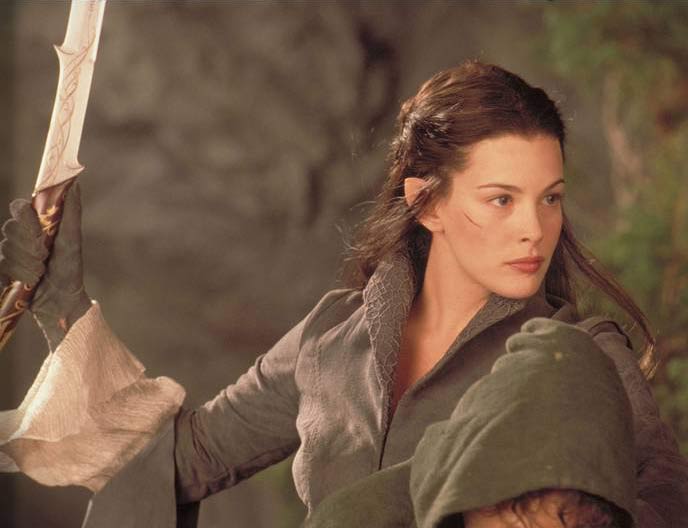 Every hero needs a heroine: Aragorn needs his Arwen, Arthur needs his Guinevere, Paul Atreides needs his Chani. In his book Wild at Heart, John Eldredge says that to be complete a man needs "a beauty to rescue" and popular culture would certainly seem to bear this out. Nearly every hero rescues his heroine and they live happily ever after.
In days gone by the heroine was often a wisp of a girl who faints at the sight of blood, screams incessantly when the monster appears, then trips and sprains her ankle during the escape. Not my idea of a heroine. Personally I lean more toward the pioneer type, bravely loading her hero's guns for him while they fight off the rustlers who would steal their ranch. One of my favorite heroines is Evelyn Carnahan (played by Rachel Weisz) in "The Mummy", and "The Mummy Returns". Though suitably terrified of the mummy she doesn't back down. Instead she stands side by side with her hero, guns blazing. In fact when her hero faces certain doom it is Evelyn that comes to the rescue.
But Jesus does not have a heroine in the gospels. There is no lover standing by his side to fend off the bad guys. Which is likely why people like Dan Brown and his Da Vinci Code keep trying to give him one. It seems wrong in human eyes for the greatest figure of all time to die a martyr's death without ever having tasted the fruits of true love. A match between Jesus and Mary Magdalene appears to solve the problem and tries, at least in part, to give the story a "happily ever after" quality. There's only one problem - Jesus already has a heroine.
The reason so many people don't recognize this fact is you won't exactly find her in the gospel of Matthew or in any of the others. Her part shows up a little later in the story.
"Husbands, love your wives, just as Christ loved the church and gave himself up for her to make her holy, cleansing her by the washing with water through the word, and to present her to himself as a radiant church, without stain or wrinkle or any other blemish, but holy and blameless." Ephesians 5:25-27
"Then one of the seven angels who had the seven bowls filled with the seven last plagues came to me and talked with me, saying, "Come, I will show you the bride, the Lamb's wife." And he carried me away in the Spirit to a great and high mountain, and showed me the great city, the holy Jerusalem, descending out of heaven from God, having the glory of God. Her light was like a most precious stone, like a jasper stone, clear as crystal. .... And they shall bring the glory and the honor of the nations into it. But there shall by no means enter it anything that defiles, or causes an abomination or a lie, but only those who are written in the Lamb's Book of Life." Revelation 21:9-11, 25-27
You see, the heroine in the story of the Gospels is the church herself. And since the church is made up of those who call upon his name then we, my dear reader, are the heroine in The Kingdom Gospel. We are the heroine He risked it all for. It was for the love of you and me that He gave everything he had to reclaim the throne that was His.
The question left for us to answer is, "What kind of heroine are we?" Are we the wisp of a girl who faints at the sight of the enemy and sprains her ankle during the escape? Or the steadfast partner, sword in hand, ready to face whatever comes as long as we are at His side? Or some other kind of heroine entirely?
I suppose that is a question each of us has to answer for ourselves, but regardless of what kind of heroine we are, Jesus remains the hero of the story. He is the rightful Heir to the Father's throne. He has faced and defeated the enemy leaving only a few minions running around for us to deal with. And one day He will retrn to claim His heroine and take her back to be with Him.
And if you check out the end of the book you will discover that we do indeed live "happily ever after."
Shalom!
--------------------------
Covering My Legal Derriere Dept.
First picture: Liv Tyler as Arwen. Lord of the Rings: The Fellowship of the Ring. Copyright New Line Cinema
Second Picture: Rachel Weisz as Evelyn Carnahan. The Mummy Copyright Universal Pictures